

Experience Digital Sovereignty Live: mgm at Smart Country Convention 2026
How can a German state replace its Microsoft Access-based applications with low-code, modernize its specialized workflows, and boost its digital sovereignty? mgm will address this and related questions at this year's Smart Country Convention (SCCON), held October 13-15, 2026 at the Berlin exhibition grounds. The company will have its own booth (hub27 | 112) and will deliver 13 technical talks over the three days.

The Deutschland-Stack Is Coming: The Architecture Is Set, Now the Specialized Applications Must Follow
With the resolution of the IT Planning Council on June 17, 2026, the Deutschland-Stack has gained new binding force. The federal government and the states have agreed on five central base components: Identity and Trust (eID, EUDI Wallet, BundID), data exchange via FIT-Connect, data retrieval via NOOTS, the central payment service, and the central mailbox. The rollout will proceed iteratively through 2028.
Double Win: “Tax Return with One Click” Wins at the 2026 eGovernment Competition
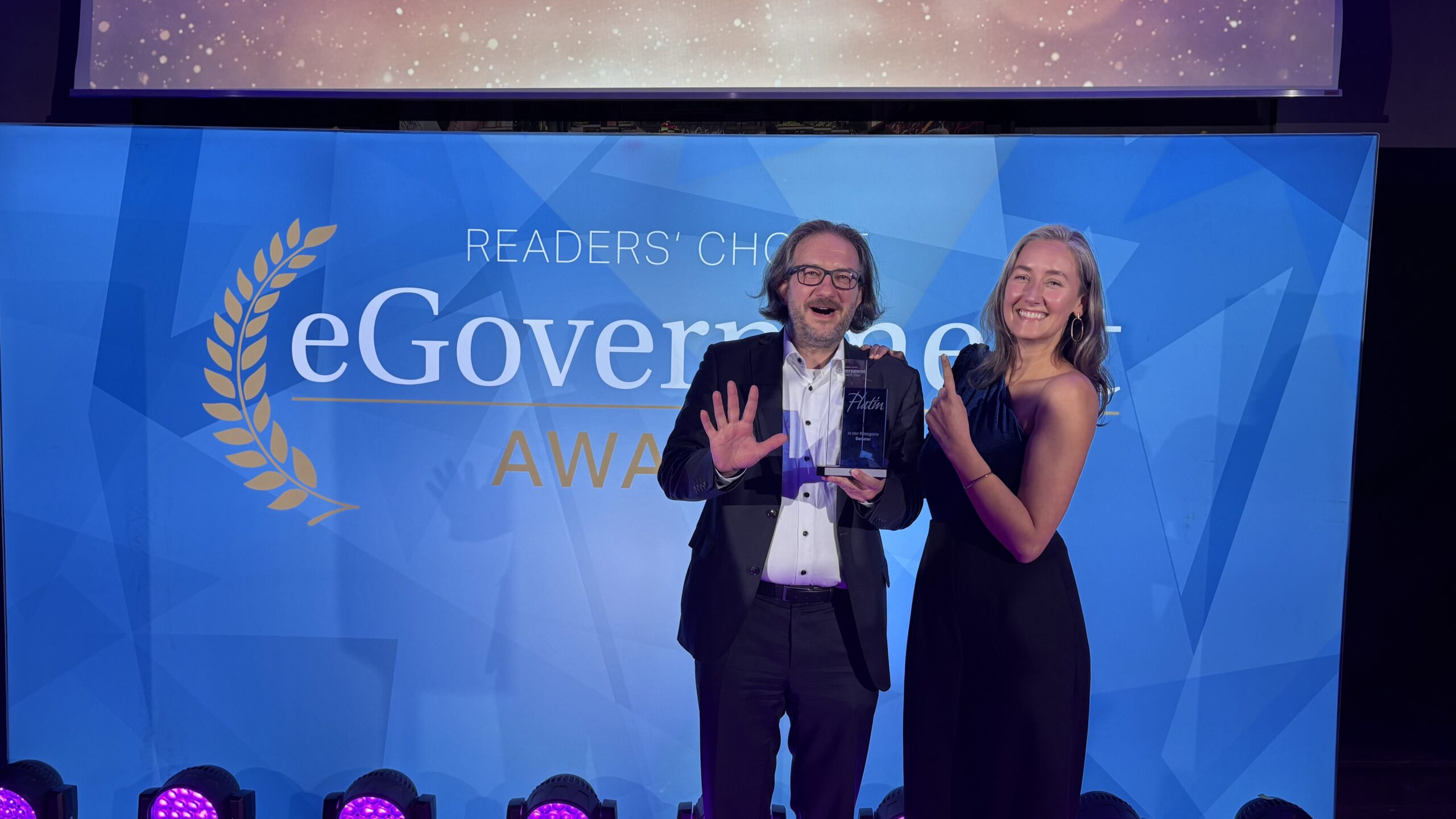
The "Tax Return via App with One Click" scored a double win at the 2026 eGovernment Competition: 1st place in the public vote and 3rd place in the jury category "Customer-Centric Administrative Processes Reimagined from Start to Finish."
mgm and IONOS CLOUD: Sovereign Public Sector Digitalization from a Single Source
mgm technology partners and IONOS CLOUD are joining forces for the public sector. The strategic partnership combines A12 specialized applications with IONOS CLOUD’s sovereign cloud infrastructure – both German providers with no dependencies outside Europe. The goal is the “A12 Public Sector Platform” as a jointly marketed end-to-end offering for sovereign public sector digitalization. The entry point is a hosted A12 AI Low Code development environment on IONOS Cloud. The first production applications are planned for late 2026.

Digital Sovereignty in Practice: mgm at the 18th Low-Code Theme Night in Berlin
On September 17, the Berlin Senate Chancellery is hosting the 18th Low-Code Theme Night at the GovTech Deutschland offices in Berlin. The focus: the role of open source in advancing sovereign digitalization of public administration. mgm is co-hosting the event this time and will present three case studies from actual projects.

Sovereignty that makes a difference: Networking event for Public Administration on November 19 in...
Sovereignty determines how effective public administration remains in times of change. That is precisely what this networking event on November 19, 2026, in Hamburg’s Speicherstadt is all about. We bring together people from the fields of public administration, consulting, and technology who have practical experience with this topic.

Vote Now: A12 at the Open Source Competition 2026
Together with the State Chancellery of Schleswig-Holstein, mgm has submitted the A12 project for replacing Access in Schleswig-Holstein to the Open Source Competition 2026. Today the community voting kicks off: every vote counts.

DATABUND and Ministry of Digital Affairs Sign Cooperation Agreement: A Strong Signal for Public...
The Federal Ministry for Digital Affairs and State Modernization (BMDS) and DATABUND — the association of mid-sized IT service providers and software manufacturers for the public sector — officially signed a cooperation agreement on July 30, 2026. The goal is clearly stated: to accelerate the digitalization and modernization of government and public administration by systematically leveraging the expertise of mid-sized IT companies. As a DATABUND member, mgm is part of this initiative.
Low-code: A key component of the open-source strategy
Following its move away from Microsoft Office and Outlook, the Schleswig-Holstein state administration continues to focus consistently on open-source solutions. With the A12 AI low-code platform from mgm technology partners, the state is accelerating the phase-out of Microsoft Access and the development of modern administrative applications.
Tax return in a single click – now easy to complete via MeinELSTER+
From today, the ‘Tax return in a single click’ service enables citizens to automatically generate simple tax returns – with just one click. The service is accessible via the MeinELSTER+ app and is initially aimed at single, childless employees and recipients of retirement income. The ‘Tax Return in One Click’ service is built entirely on the A12 AI Low Code Platform from mgm technology partners, which has formed the technological foundation of ELSTER for many years.