
Last Updated on 2. September 2026
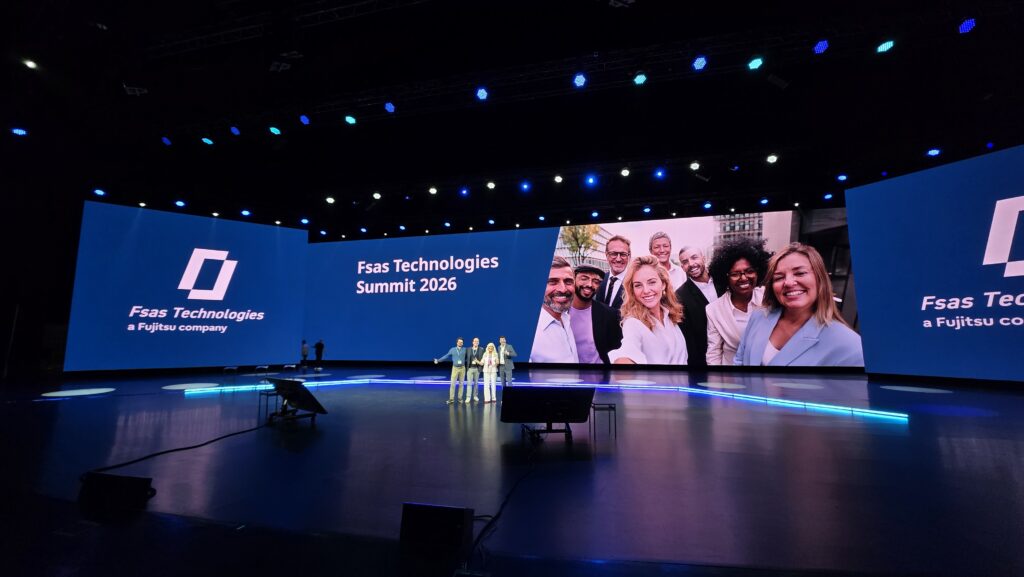
How can technological progress be reconciled with responsibility? This was the central question of the opening keynote at the Fsas Technologies Summit 2026, held on July 1 and 2 at the Showpalast Munich. Fsas Technologies, a Fujitsu Group company, is a data center solutions provider with a European-Japanese background. Over the two days, the summit brought together around 2,100 people in total: customers, partners, and IT enthusiasts. The agenda covered topics including artificial intelligence, digital sovereignty, and building future-ready IT infrastructures.
The Fsas Technologies Summit 2026
Santosh Wadwa, Vice President & Head of Platform Business Germany at Fsas Technologies, summed up the starting point: “Digital transformation concerns every company in Germany, whether the client is private or public. Artificial intelligence, cloud computing, cybersecurity, and quantum computing are driving innovation forward. At the same time, however, geopolitical dependencies, costs and risks, and legal challenges are also growing.”
This tension ran through the entire program. The breakout sessions addressed societal and technological megatrends and their concrete impact on the IT strategies of companies and public sector clients, complemented by real customer showcases from the data center space. In her keynote, political economist Prof. Dr. Maja Göpel captured the summit’s guiding question: “How do we create resilience, digital sovereignty, and trust?” She argued that Europe needs an industrial policy clearly oriented around its own strengths.
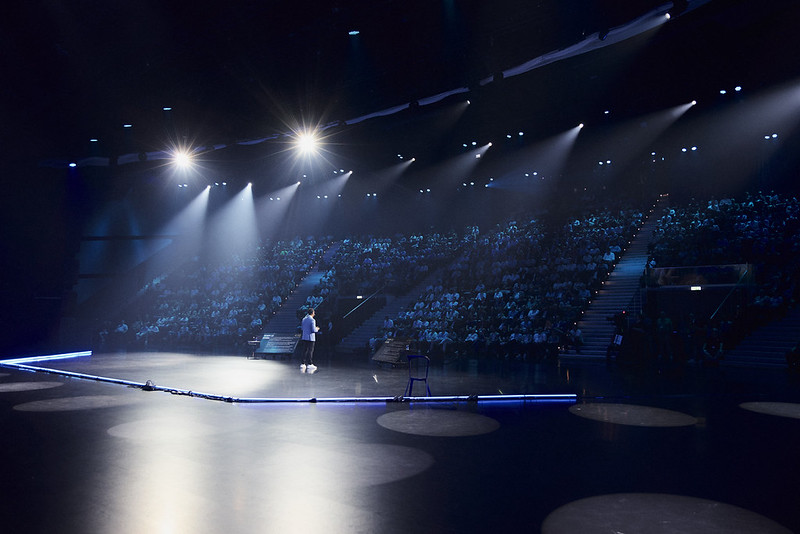
Agentic Coding for Critical Infrastructure: Dr. Jan Jikeli’s Talk
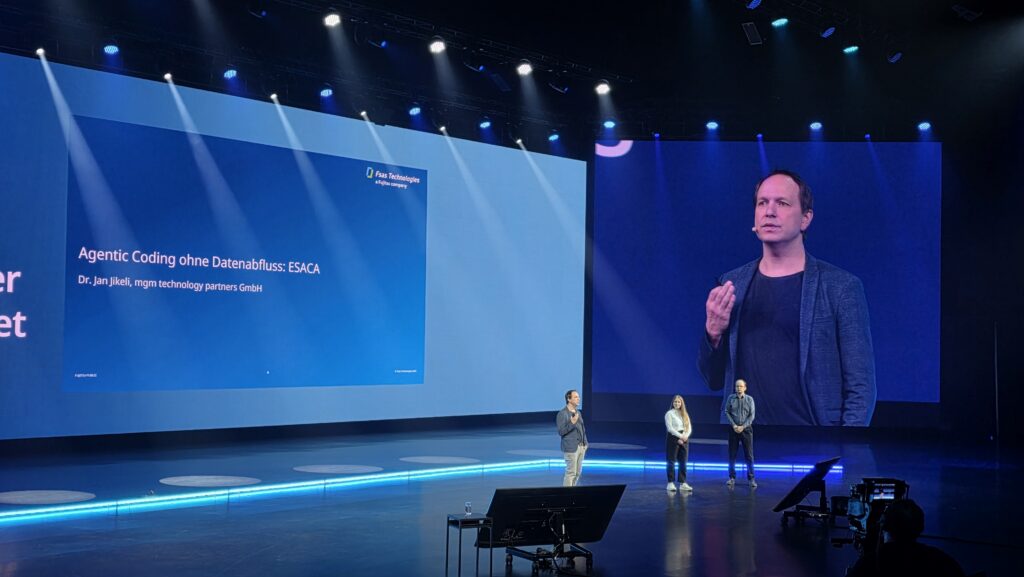
What digital sovereignty can look like in practice in software development was demonstrated by Dr. Jan Jikeli, Head of Artificial Intelligence at mgm technology partners, in his contribution “Agentic Coding without Data Leakage,” as part of the breakout session “Private AI: How SMEs Work Securely with Generative AI” alongside Tatjana Greim, Fsas Technologies, and Thorsten Mennig, BYTEC Bodry Technology GmbH. At the center was ESACA, the European Sovereign Agentic Coding Appliance, developed by mgm together with Fsas Technologies.
The starting point, according to Jan Jikeli, is a leap in productivity that is currently fundamentally transforming software development: “Modern agent systems can solve tasks—coding tasks, testing tasks—that take around 100 hours. We expect this productivity leap to continue growing.”
The problem with this is that common coding assistants cannot be used in critical infrastructure. That’s because doing so causes intellectual property to leave the premises, resulting in a compliance conflict. Whether it’s tax data or other sensitive information, every critical infrastructure company has data it must not or does not want to share externally.
The approach: agentic coding without data leaving the data center
The technical building blocks for sovereign agentic coding already exist in the form of open-source models and agent systems as well as local infrastructure. Many critical infrastructure companies therefore provide such environments themselves. ESACA professionalizes this approach, and mgm contributes several years of experience in agentic development in the commerce and insurance sectors, so that critical infrastructure companies can become productive faster. Four principles are central to this:
- Air-gapped: The system is completely disconnected from the internet—there are no incoming or outgoing connections. The models run on-site, package managers access internal mirror repositories, and the agent works exclusively with locally available tools. This is often mandatory for high-security environments such as government agencies or financial institutions.
- Sovereign models: Models are used over which the company retains full control itself.
- Open source: The architecture consistently relies on open components, without vendor lock-in.
- Audit-capable by design: Every action taken by an agent is traceable, logged, and verifiable. This is not an afterthought or add-on feature, but a foundational architectural decision. The audit trail records which files were read or modified, which commands were executed and with what result, and at which points a human approved an action. Precisely because agents can autonomously execute hundreds of steps before a human intervenes, this seamless traceability is essential for regulated environments.
Workbench and Benchmark: Achieving the productivity leap with open-source models
One objection comes to mind: can open-source models even keep up with the frontier models from major providers? While the capabilities of open-source model agents are also growing exponentially, there is still a considerable gap: the difference compared to frontier models is currently around sevenfold. However, the key insight from mgm’s practical experience is that if the environment is set up correctly, the productivity leap can also be achieved with open-source models.
This requires two tools: the Workbench and the Benchmark.
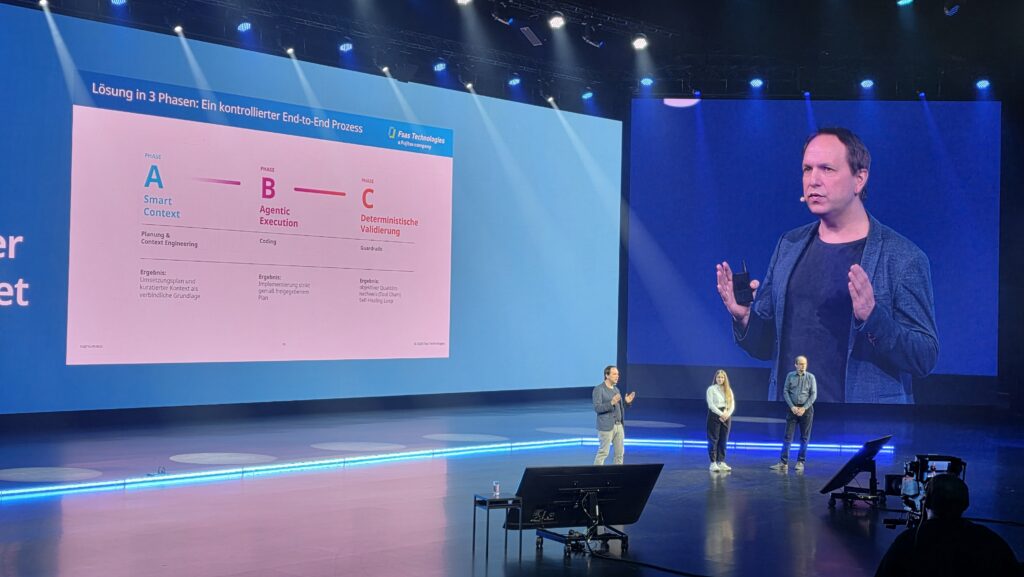
- The Workbench is a secure framework for agentic development. Its interface connects multi-agent coding in an enterprise context with Jira, GitHub, and Bitbucket, and orchestrates agents across the entire software development lifecycle. The core principle consists of three phases: (1) a planning step (“Smart Context”) with the appropriate tooling, (2) agentic execution, which works particularly well with open-source models, and (3) deterministic validation. Only this combination makes agentically developed software truly production-ready.
- The Benchmark proves that the agents deliver real added value. There are thousands of public benchmarks, but none of them run on your own company’s systems, tasks, and repositories. ESACA’s benchmarking tool makes the agent system measurable exactly where it counts: in your own environment.
The AI Adoption Framework: Tooling alone is not enough.
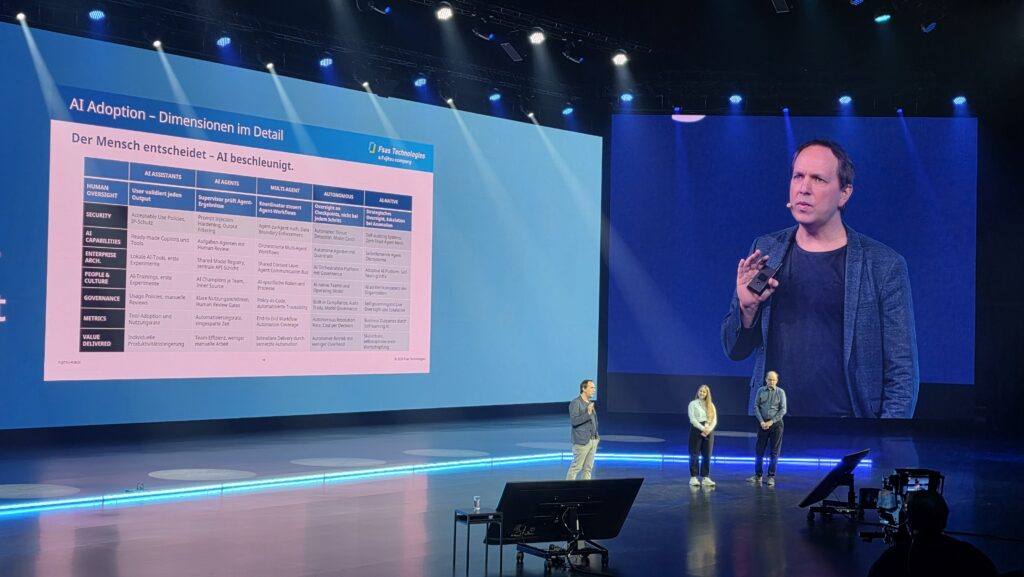
Enabling the organization is a factor that is at least as important as the technology. To address this, mgm has developed the “AI Adoption Framework.” The framework describes five stages, from “AI Assistant” to “AI Agents” and “Multi-Agent Orchestration,” and finally, “AI-native” systems. In the latter stage, agents learn from one another through feedback. However, the major promises of the AI world are only fulfilled in the higher stages, when agents work in a self-directed and adaptive way. Business models only begin to transform at this point because a system that learns independently as a whole is the only one that enables new forms of value creation, not just the more efficient design of existing processes. Each stage has its own requirements, such as those related to people and culture, change processes, and security. The greater the agents’ scope of action, the greater the need for control.
This exact connection between technology and organizational change is at the core of every successful AI adoption and has been a core competency of mgm consulting partners for years. “A framework like the AI Adoption Framework only unfolds its value when technology and organizational development are considered together from the very start. That’s precisely what we’ve been supporting in transformation projects at mgm consulting partners for years,” says Roland Kreutzer, Partner and Head of Public Sector Consulting at mgm consulting partners.
For critical infrastructure companies, a clear recommendation follows from this. They should start immediately training their teams in working with agent systems, initially, for example, via sovereign cloud providers in a self-service model. At the same time, their own hardware should be planned, since lead times are long. Once the hardware is in place, the Workbench and Benchmark can be set up. Finally, the organizational transformation should be tackled collaboratively.
Q&A: Effort, added value, and the European perspective
The subsequent Q&A session made clear where the real challenge lies. Asked about the most demanding part of the development, Jan Jikeli replied: “The development of ESACA is ongoing, because what you build now will be outdated in a year. The real competency lies in evaluating and understanding the market. The technology itself can always be developed further, but staying innovative is not easy.”
And the added value? The greatest benefit lies in being able to run agentic coding securely in a sandbox without security leakage. For critical infrastructure, this is of central importance. On top of that, there’s the efficiency gain: according to mgm’s experience, teams working with agentic coding are around 20 to 30 percent faster. Jikeli has observed this with his own team. Quality also improves, as documentation gets better, test cases improve, and the software overall becomes more stable.
In closing, Jan Jikeli put the partnership with Fsas Technologies into strategic perspective: “The big challenge for us Europeans is that we need to form alliances. What we’re currently observing is that the major coding agents are also dictating the architecture of the future. That means not only development but also what we call innovation becomes dependent on them. We need to respond to that, and ESACA is a first step in that direction.”
ESACA as a strategic topic: impressions from the booth
That this topic strikes a chord with the times was also evident beyond the breakout session. Interest in ESACA was high in the exhibition area as well. Conversations with Fsas Technologies’ strategic partners, with service providers, and with hardware manufacturers confirmed: ESACA fills exactly the gap that currently exists in the market.
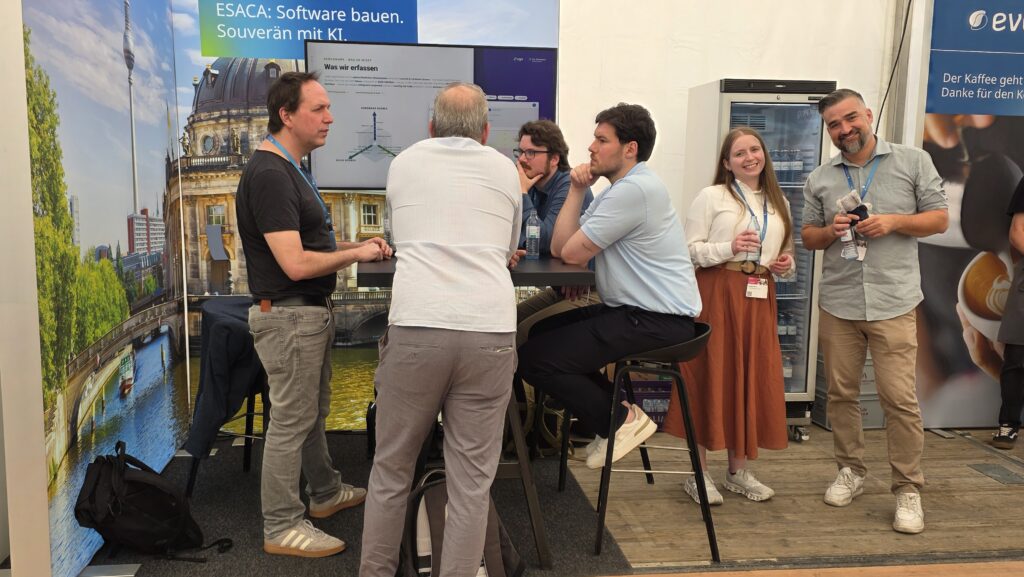
ESACA booth at the Fsas Technologies Summit 2026
Conclusion: Agentic coding is a strategic question for critical infrastructure companies
In just two days, Fsas Technologies managed to educate 2,100 individuals on the fundamentals of AI, digital sovereignty, and sustainable infrastructure, preparing them to embark on their digital transformation journey. For MGM, the summit demonstrated that sovereign agentic coding is a strategic question for every critical infrastructure company, not a niche topic. ESACA now provides an answer to this challenge that doesn’t pit productivity against compliance.
Questions about ESACA? We’re happy to advise you.
Further information
- Website of the Fsas Technologies Summit 2026 in Munich (German): https://eu.fsastech.com/de/microsites/fsas-technologies-summit-2026/
- ESACA website: https://esaca.eu/?lang=de
- Dr. Jan Jikeli’s talk at the Fsas Technologies Summit 2026 (YouTube; German): https://www.youtube.com/watch?v=zJZxYfoeTZM
- Blog article “ESACA: mgm and Fsas Technologies launch cooperation for sovereign AI-supported software development”: https://insights.mgm-tp.com/en/2026/company/esaca-mgm-and-fsas-technologies-launch-cooperation-for-sovereign-ai-powered-software-development/