Last Updated on 8. June 2026
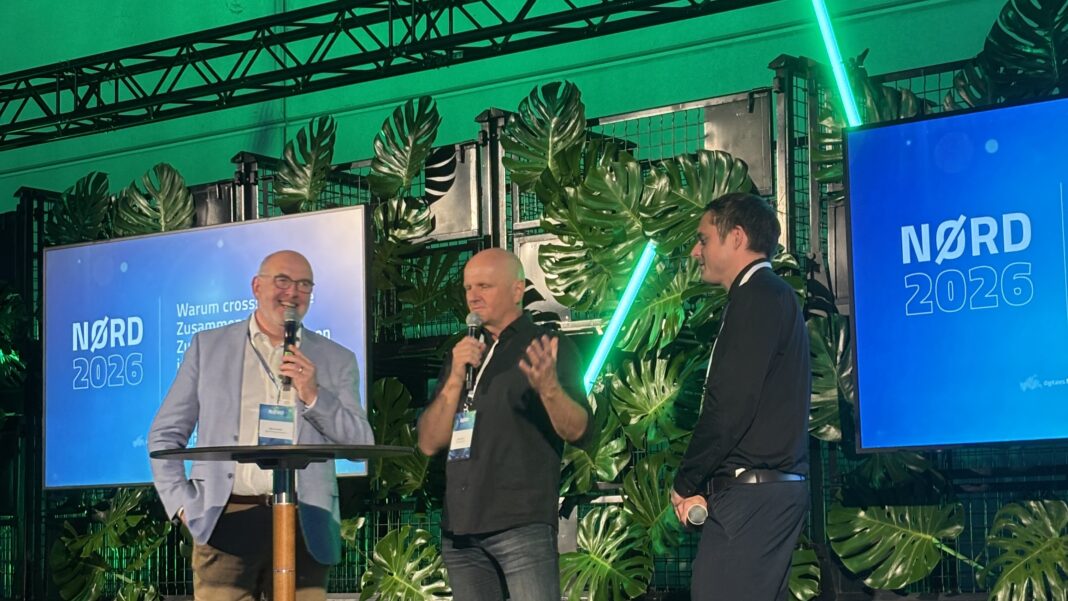
In this episode of Innovation Implemented, Hauke Rickertsen from the Ministry of Finance and Digitalization of Mecklenburg-Western Pomerania, Raik Writschan from the City of Rostock, and Marcus Warnke from mgm consulting partners at Noerd in Rostock discuss what happens when the state, local governments and municipalities establish genuine joint structures: a joint steering committee, shared program responsibility, and a consolidated digitalization strategy that doesn’t stop at improving convenience but aims for efficiency gains and automation.
The conversation is honest, concrete, and relevant for anyone who is working on similar structures themselves or wants to know what it really takes to ensure that administrative digitization doesn’t get bogged down in a marathon of coordination.
Listen to the podcast
In this interview: Hauke Rickertsen from the Ministry of Finance and Digitalization of Mecklenburg-Western Pomerania, Raik Writschan from the Hanseatic and University City of Rostock, and Marcus Warnke from mgm consulting partners
Moderator: Karsten Kneese, Marketing Manager, mgm
Duration: 29 minutes
Key points at a glance
Question 1: Joint program structures instead of individual projects
The decisive impetus came from the COVID-19 crisis: The administration had to ensure its ability to act, and the growing challenges (budgetary pressure, cyberattacks, demographic change) cannot be tackled alone by any single department or level of government. Programs serve as a unifying framework that makes interdependencies visible and enables coordinated management. The core problem with individual projects: Digital transformation is not a construction project. It requires cultural change, and isolated projects inevitably reach resource limits when dealing with large-scale initiatives. Without shared objectives and coordinated projects, the “Berlin Airport effect” arises: many parallel efforts, little coordination, and no sustainable results.
Question 2: Steering Committee – Budget, Priorities, Conflicting Interests
The structure has existed for nearly 20 years and is composed of equal representation: four representatives each from rural districts, independent cities, and ministries, with umbrella organizations involved, operating under the principle of unanimity. The culture is fundamentally consensus-oriented. The budget was long the weak point: there was a free-for-all, strategic oversight was lacking, and some were unable to access funds at all. The response to this is a joint digitalization strategy, which is currently being finalized. It is intended to prevent projects from having to be negotiated politically on a case-by-case basis in the future—projects that do not contribute to defined goals will not even be started. In addition, portfolio management is being established to consolidate needs and manage finances in a targeted manner. A sign of the new direction: a small innovation fund for experiments where failure is explicitly permitted.
Question 3: Facilitators and Translators – Empowering People
The lack of communication between subject matter experts, IT, and management is one of the main causes of IT project failure. Cross-functional teams that bridge the gap between technology and subject matter expertise are the structural solution to this problem. Rostock recognized this early on and, starting in 2018/2019, purposefully built a team of project managers, process digitizers, and requirements managers—people who understand the complexity, can engage with business departments, and support projects. Without this team, the OZG implementation would have failed, because the subject matter expertise itself was limited to analog operations in terms of staffing and had no capacity for change. At the state level, the EgoMV special-purpose association is being strengthened to take on precisely this coordinating role across the region. According to Marcus, however, something else is needed beyond structures and empowerment: proactive stakeholders who are willing to forge ahead in gray areas without everything being fully secured yet. And for that, it requires backing from leadership and the commitment to allow for mistakes.
Question 4: From Improved Convenience to True Efficiency and Automation
It is openly acknowledged that digitization to date has improved access but has done little to reduce staffing levels or process costs. Simply digitizing and piecing together documents is not enough. The next step is process and data automation: the example cited in the discussion is the change of address. When someone moves, they re-register with the residents’ registration office, but the vehicle registry knows nothing about it. This pointless loop of media discontinuity should be eliminated through automatic registry linkage. Centralizing cross-functional processes (referred to in the discussion as “delocalization”) is intended to help relieve administrative staff across the board of routine tasks. The real hurdle, however, is not technological—it is organizational: processes, data, and responsibilities must first be clearly defined before AI use cases can take effect.
Question 5: What other countries and municipalities should take away from this
Three factors are mentioned.
- First: clear leadership commitment from the very beginning—at the state secretary and mayor level, with explicit permission to make mistakes.
- Second: a degree of selflessness among all participants—not putting one’s own perspective first, but stepping back to the meta-level and recognizing that everyone benefits from a joint approach.
- And third, as Marcus adds: harnessing the right momentum. The pandemic, the OZG, now registry modernization, cloud and platform strategies, digital sovereignty—these are moments when persuasion comes more easily and structures can take shape.
Those who seize this momentum to establish coordinated action will have a real advantage.
Previous podcast episodes on this topic: