

Last Updated on 4. June 2026
Imagine your government agency receives a bill at the beginning of the year. The software licenses for day-to-day operations have gone up in price again, this time by 17 percent. No room for negotiation, no alternatives. Many government agencies in Germany have built up digital dependencies from which they can hardly free themselves today. There is more to this than just an IT problem: it is about who retains control over critical digital infrastructure. It is about digital sovereignty.
The term now appears in nearly every digital strategy at the federal, state, and local levels. But what does it actually mean? Digital sovereignty is an administration’s ability to decide for itself:
- Which software is used?
- Who has access to which data?
- And: Can the administration remain capable of acting if a provider changes its terms, discontinues its service, or comes into political conflict with European values?
Specific events have brought the issue to the forefront: dependencies on U.S. cloud services, licensing disputes, and the withdrawal of individual providers from certain markets. Both the European Commission and the German federal government have declared digital sovereignty a strategic priority. Digital sovereignty is not an option. It is a decision.
The vendor lock-in problem: When choice becomes an illusion
In many government agencies, systems introduced ten or fifteen years ago still shape daily work—tailored to a specific platform, with staff trained on it, aligned processes, and data in proprietary formats.
A switch would be theoretically possible, but is supposedly so complex, risky, and costly that it is hardly ever seriously considered. The vendor knows this and calculates accordingly. For private companies, this is inconvenient. For the public sector, it is a democratic problem: tax dollars flow into dependencies rather than into performance.
The consequences:
- Rising costs without corresponding value
License fees rise without the software improving, and negotiations rarely yield results because the administration’s bargaining position is weak. - Lack of adaptability
Every process change—whether due to new laws, growing public demands, or new government structures—requires a request to the manufacturer. This costs time and money. - Data protection risks
Software on servers outside the EU raises fundamental questions: Who has access to the data? Which law applies? What happens in the event of a foreign court order? - Invisible dependencies
Many administrations do not realize the extent of their dependencies until a contract expires or a provider runs into trouble. By then, it is often too late for an orderly response.

Why open source is the solution and why now is the right time
Open source means that a software’s source code is publicly available. At first glance, this may sound like a technical detail, but it represents a paradigm shift: from dependency to control, from a black box to transparency, from lock-in to freedom of choice. Open source explicitly does not mean doing without professional software. It does not mean that the IT department has to develop everything itself, or that support no longer exists. Open source means: control shifts from the provider to the organization using the software.
Schleswig-Holstein, Munich, and many others prove that this works, as does the European Commission’s active promotion of open software. The timing has never been better: With the Online Access Act (OZG) and other regulations, the digitization of public administration is under pressure to act. New applications must be developed, and existing ones modernized. Those who decide now on what basis this will happen are setting the course for the next ten to fifteen years.
A12 AI Low Code Platform: True digital sovereignty from Germany
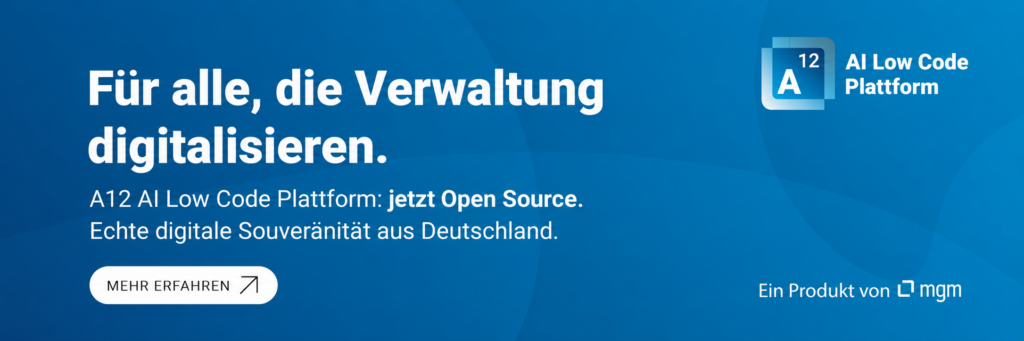
For public administrations that want to take this step now, there is a concrete solution: A12. The A12 AI Low Code Platform has been in use by German government agencies for years—including the ELSTER tax platform—and is now available as open source. A12 follows a low-code approach: administrative processes can be modeled, customized, and put into operation without in-depth programming knowledge. Departments can actively participate in the design process instead of having to wait for external service providers for every change. This means shorter implementation times, fewer dependencies, and a platform that grows with the administration’s requirements rather than restricting them.
Developed in Germany, tested in public administration, open to all: A12 demonstrates what digital sovereignty looks like in practice.
Here you can find more information about A12’s open-source release: