


Last Updated on 24. June 2026
In virtually every company, it has long been on paper: the IT strategy, closely integrated with the business strategy, with clear goals and defined priorities. And yet, implementation is proving difficult. Budgets are insufficient, resources are scarce, and entrenched structures offer silent resistance. It is precisely this gap between strategic aspirations and operational reality that mgm consulting partners have examined in detail in their latest CIO study.
The survey polled IT decision-makers from a broad mix of industries, ranging from IT services to retail and mechanical engineering to public administration. The picture that emerges is honest, sobering in some respects, surprising in others, and confirms much of what executives have long suspected.

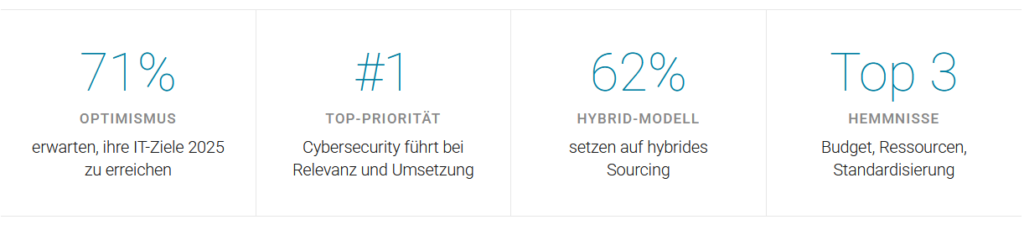
Five Findings from the CIO Study
1. The strategy is in place. Implementation is stalling.
Most companies have a clearly defined IT strategy that is aligned with their business strategy. Nevertheless, a significant proportion of respondents still do not view their own IT as a strategic enabler. Digitalization is underway, but rarely “on time” and “on budget.” Where this happens, it is almost never due to a lack of will. It is almost always due to on-site conditions.
2. Cybersecurity dominates. AI has lost its mystique.
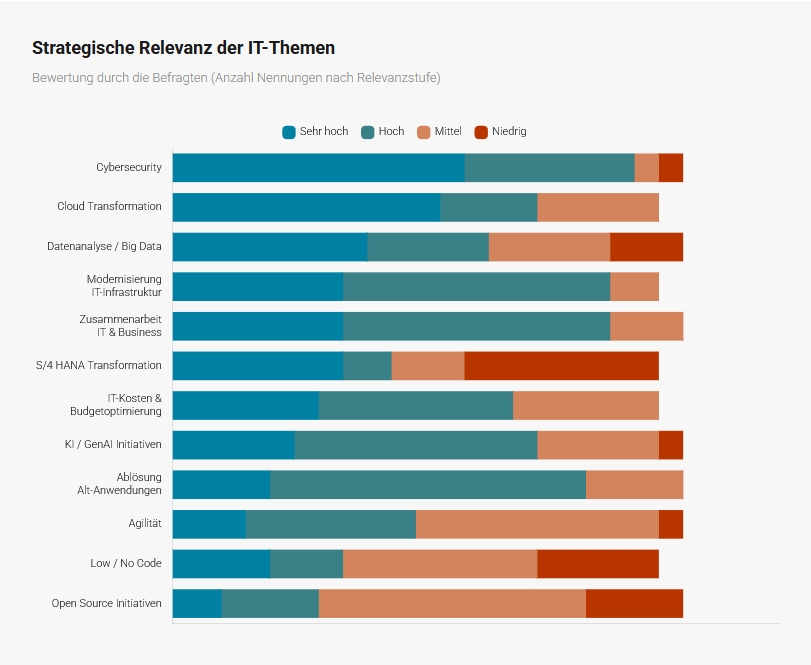
In terms of strategic relevance, cybersecurity and cloud transformation lead by a wide margin. AI and GenAI land in the middle of the pack, a finding that would have looked very different a year ago. Following the peak of the hype, AI is treated in many organizations as a bundle of operational use cases, not as a scalable transformation program. In terms of implementation progress, cybersecurity and S/4HANA are in the lead. Bringing up the rear is the replacement of legacy applications, a tough issue that no one likes to tackle.

3. Budget, Resources, Complexity: The Three Major Obstacles
Budget constraints top the list. Dependencies and integration efforts are often underestimated in the target vision and catch up with projects later on. Resource bottlenecks are not a new phenomenon, but a constant companion. Added to this is a lack of standardization amid high complexity, which makes any strategic course correction difficult.
There is also good news in the data: a lack of willingness to change on the part of IT is rarely cited as an obstacle. Organizations are accustomed to change. It is less about attitude and more about leverage.
4. Zero Trust Tops the Priority List
For the next three years, CIOs are focusing primarily on three areas: Zero Trust Security and Data Sovereignty at the top, followed by Cloud First and hybrid IT, as well as AI-Driven IT Operations. By a wide margin, the most important core task of the CIO role is aligning IT and business strategy. IT cost optimization and hyperautomation rank surprisingly low—two topics currently given more weight in industry media than they actually hold in practice.
5. Cautious Optimism
Nearly three-quarters of respondents expect to achieve their IT goals by 2025. They cite focused project work with dedicated resources, end-to-end digitalization instead of siloed solutions, reduced complexity, and clear implementation roadmaps as the most important levers for success. That sounds simple. It is. And that is exactly why it is so difficult.
What remains
The CIO study paints a picture of an IT landscape that knows exactly where it wants to go strategically, but has to fight for every step operationally. The truly interesting question is not whether the right priorities have been set. For the most part, they have. The more interesting question is how consistently companies create the conditions under which implementation succeeds: dedicated teams, fewer major projects running simultaneously, and realistic roadmaps with buffers for what is most underestimated in any transformation—namely, integration.
Download the full CIO study
You can find all results in detail, over ten charts, analysis by industry and company size, as well as concrete recommendations for IT decision-makers in the free full version.