

Last Updated on 29. January 2026
To me, quality engineering is much more than a modern buzzword. It’s a mindset and a structured approach to ensuring software quality in a sustainable, scalable, and cost-effective manner. While traditional software testing focuses on identifying differences between the expected and actual states, quality engineering has a different goal. Quality is not created through end-of-process control, but by deliberate design from the beginning.
Quality Engineering as a Systemic Approach
Although the term “quality engineering” is not formally defined in international standards and training frameworks such as ISO, ISTQB, iSAQB, or IREB, the concept is well understood today. Quality engineering is an organizational and methodological synthesis. It unites architecture, processes, automation, data, models, and tools into an integrated system that ensures quality throughout the entire software lifecycle. Concepts such as Shift Left, Built-in Quality, Continuous Testing, testability, automation architecture, and test data engineering are not isolated practices but rather expressions of this approach.
In my view, quality engineering encompasses all activities that make the quality of complex software systems predictable, controllable, and scalable. In other words, it is about an architecture and an ecosystem of processes, data, and tools that enable quality assurance at scale. Extensive manual testing is unrealistic for complex, long-lived software systems, and traditional approaches to test automation quickly reach their limits. What is needed are structures that support quality systematically, scalably, and sustainably—from business requirements to production operations.
Quality Across the Entire Lifecycle
Quality Engineering does not end with a successful test or go-live. Performance, stability, security, and usage patterns only become fully visible in real-world operation. Telemetry, logging, monitoring, and user feedback are therefore part of the same quality system and are fed back into models, tests, and requirements. Quality Engineering connects “Shift Left” with “Shift Right” and creates closed feedback loops in which systems continuously learn from real usage.
From Requirements to Formal Domain Models
This starts with requirements. Quality Engineering ensures that business rules, dependencies, and quality attributes are not only documented, but also formalized, structured, and described in a way that allows analysis. As a result, they are testable, measurable, and automatable from the very beginning. In this context, IREB and ISTQB refer to testability, consistency, and explicit quality requirements. In Quality Engineering, however, these properties are not merely demanded—they are technically and methodologically ensured.
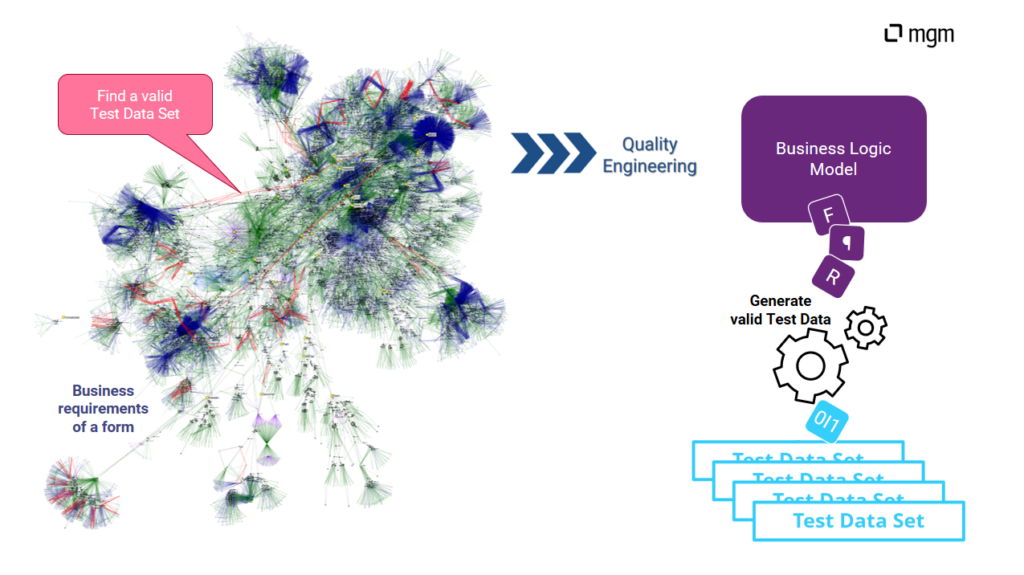
In practical terms, this means that the domain logic is first captured in the form of a model. Within this model, business rules, dependencies, and calculations are explicitly described. By systematically validating the model for completeness, consistency, and domain correctness, gaps, inconsistencies, and contradictory rule chains can be identified and resolved early on. This is precisely where Quality Engineering’s core becomes visible: domain quality is deliberately designed and safeguarded within the domain model itself, rather than discovered later during testing. This creates a valuable, robust, and reliable foundation for generating valid test data, test scenarios, and verification mechanisms.
Quality Beyond Functionality
According to ISO 25010:2011, software quality encompasses more than just functionality. It includes characteristics such as reliability, security, maintainability, performance, usability, and accessibility, among others. Quality engineering integrates these attributes into architectural decisions, data models, test strategies, and operational processes rather than treating them in isolation. Thus, quality is actively shaped and monitored throughout the entire lifecycle, not merely tested. Read more
Scaling in Highly Complex Domains
This is particularly evident in large eGovernment platforms, such as those developed by mgm. These platforms converge extreme domain complexity, regulatory requirements, and long product lifecycles. The sheer number of rule combinations, input fields, and form variants makes manual quality assurance impractical, even with large teams. Instead of executing as many tests as possible, the goal is to deploy limited QA resources precisely where human judgment is indispensable: usability, accessibility, domain evaluation, and risk assessment. Everything else must be systematically supported, modeled, and automated.
Test Data as an Engineering Artifact
The Q12 test data generator used at mgm is a good example of this. It perfectly embodies the idea of quality engineering. For complex tax forms, random test data is insufficient. Instead, what is required are domain-valid, realistically distributed, rule-compliant data sets with high test coverage. The domain logic itself becomes the model from which high-quality synthetic test data is systematically generated. Thus, quality emerges deliberately, reproducibly, and cost-effectively.
Automating Test Automation
My personal interest in quality engineering was sparked by end-to-end test automation in particular. In large systems with thousands of fields, it quickly becomes clear that traditional, manually coded UI tests are not scalable. The countless setter and getter methods, selectors, and validation routines required lead to a significant maintenance burden and high resource consumption. This is not sustainable engineering.
Out of this tension, I developed my model-based innovation: automating test automation. Domain logic and UI models serve as the central source from which the entire test code—including all identifiers, as well as all input and verification methods—is automatically generated. A self-developed interpreter reads the generated code and uses it during automated test execution. After initialization, the interpreter is invoked as needed from a test case implemented in QF-Test. The interpreter ensures that the QF-Test test automation tool processes the respective form blindly, systematically, and field by field, either by filling it out or by validating it, depending on the test objective.
Seeing such a tool fully and correctly process highly complex forms was a key moment for me. This is exactly where the essence of quality engineering becomes evident—not fighting for testability and automation manually, but producing them industrially.
Read more about automating test automation

I am most excited about the combination of technical depth, strategic impact, and creative freedom in Quality Engineering. As a software developer and quality engineer, I design innovative software solutions for a wide range of needs. These solutions make quality assurance in software development projects scalable and effective in the long term. As a result, testing activities are simplified, accelerated, standardized, reproducible, and scalable without compromising quality. With each repetition of a testing activity, the value created by quality engineering increases.
Quality as a Controllable System
To me, quality engineering means viewing quality issues as part of an overall system. This involves more than just testing quality at the end; it also means actively making quality controllable through measurable criteria, appropriate architecture, and automation. It also means designing scalability — both technical and organizational — in a way that remains manageable as complexity grows. Most importantly, it means freeing people from repetitive, error-prone work and giving them the opportunity to focus on areas where human expertise is indispensable: thinking, evaluating, designing, and deciding. Quality Engineering also deliberately brings innovation to where it creates real value: the structures that carry quality.
Quality engineering makes quality scalable because quality no longer has to be purchased through increased effort. Quality Engineering creates reusability because once-developed generic software solutions can be used across many projects and over many years. Quality Engineering reduces operating costs by detecting defects earlier, reducing manual effort, and reliably controlling regressions. At the same time, quality engineering increases the stability of complex system landscapes and reduces risk because quality is supported by architecture, data, and automation rather than left to chance.
Economic Control of Quality
Quality engineering transforms the economic management of quality. Rather than investing in ever-increasing testing efforts, investments are redirected toward structures and mechanisms that enable the systematic observation, evaluation, and control of quality. Thus, architecture, data management, testability, automation, modeling, and monitoring become strategic investment dimensions with long-term leverage.
Business rules, technical dependencies, process paths, usage behavior, defect rates, and risk profiles form an integrated quality picture. These factors are continuously analyzed using tools and data. As a result, areas of true complexity, regulatory sensitivity, and operational criticality become visible. Based on this analysis, quality can be prioritized: high-risk business logic, security-relevant functions, heavily used paths, and error-prone areas receive stronger safeguards than stable, low-criticality zones. Quality engineering replaces blanket testing efforts with risk-based, economically sound quality control. Quality evolves from an abstract attribute into an actively controllable variable that is technically grounded, economically justifiable, and strategically usable.
AI and Quality Engineering
Artificial intelligence does not replace human expertise in quality assurance; rather, it extends the reach and effectiveness of quality engineering. Modern QE systems generate large amounts of structured information, including domain logic models, test data spaces, coverage metrics, runtime data, defect rates, usage profiles, and dependency graphs. These artifacts form an ideal data foundation for AI applications.
AI can identify patterns that are difficult for humans to detect, such as unexpected rule interactions, anomalies in data spaces, shifting risk profiles, and gradual erosion of test coverage. AI can dynamically adjust test priorities, identify risk areas early on, and generate suggestions for additional tests, data variants, or model refinements. As a result, quality is continuously observed and proactively managed, not just tested.
However, it is crucial to note that: AI only delivers value where structure already exists, through quality engineering. Without clean domain models, consistent test data, defined quality metrics, and a robust automation architecture, AI is merely a random generator. AI can only derive reliable, explainable, and actionable insights when quality is technically described, made measurable, and systematically captured.
This interaction creates a new level of industrial quality assurance. Quality engineering provides the formal foundation while AI amplifies analytical, predictive, and optimization capabilities. This transforms reactive defect detection into an adaptive, learning quality system that continuously improves as complexity grows.
Quality Engineering as a Mindset
Ultimately, however, quality engineering is more than just technology; it’s a mindset. It means taking responsibility for the entire system, identifying risks, sharing knowledge, and empowering individuals. In a QE-driven organization, quality stakeholders from QA, development, architecture, and the business domain collaborate based on shared models, data, and quality objectives rather than working in silos.
Rather than delegating or shifting responsibility for quality elsewhere, it is shared across the entire value chain—from business requirements to technical implementation to operations. Quality is created not through control at the end, but through competence, transparency, and collaboration from the beginning. This is precisely what makes the field exciting to me and why I see it as one of the most important levers for the future of professional software development.
Curious to learn more?
How mgm makes quality in complex systems manageable with the Q12 Landscape — from domain models to automation —learn more here:
Go to the Q12 Landscape