

Last Updated on 8. June 2026
The statutory e-invoicing obligation demands answers — not products. While the market reflexively reaches for large platform solutions, a second look is worthwhile: not every compliance requirement needs a subscription. Not every process needs the cloud. And not every investment needs to recur for five years.
When Compliance Becomes an Architecture Question
Since January 1, 2025, e-invoicing has been a legal reality in Germany. Companies must be able to receive e-invoices in B2B transactions. From 2027, the obligation to send them applies to larger mid-sized companies; from 2028, to all businesses. With the EU’s ViDA initiative in 2030 at the latest, the topic becomes pan-European.
That covers the regulatory side. The more interesting question is what lies behind it: how do we fulfill an obligation without strategically locking ourselves into a dependency we never wanted?
Because compliance is rarely just a process issue. It is also an architecture question — and therefore a leadership question. The answer many companies give today is the obvious one: a platform. One comprehensive solution that covers everything else as well. The roadmap, the future, the EU countries. In some cases, that is exactly right. In others, it is an oversized response that exacts a cost for years to come.
The Blind Spot in the Business Case
When evaluating platform solutions, most comparisons focus on the implementation project. That is understandable — and often misleading. The true cost structure only becomes visible when you extend the view to five years.
Three cost blocks quietly accumulate:
- Platform licenses. Cloud-based solutions bill annually. The figures typically run into the mid five-digit range per year — with steady price increases that average between ten and fifteen percent at many vendors.
- Volume fees. The more documents processed, the higher the ongoing costs. For companies with growing transaction volumes, this is a business model that scales with their own success — unfortunately on the cost side.
- Dependency. This block does not appear on any balance sheet, but it is real. Whoever commits to a platform accepts its roadmap, its pricing policy, and its prioritization. Switching becomes more expensive with every passing year.
The result: an investment decision that looks like a one-time project cost at the moment of signing reveals itself in controlling after three years as a growing OpEx line item — with limited negotiating power.
A Different Perspective: Digital Sovereignty at the SAP Core
There is a second path. One that in the mgm world has long been associated with a single concept: digital sovereignty. This means retaining ownership of and knowledge about your own systems and data — independent of external roadmaps, independent of licensing models, independent of cloud dependencies.
In the context of e-invoicing, this means: the solution resides where the data already lives — in the SAP system. It uses the tools SAP provides. It produces an artifact that meets the legal requirements, and it delivers that artifact through the channels the company already uses.
No additional platform. No cloud subscription. No third-party vendor sitting between the company and its own invoices.
This is not an ideological position — it is a pragmatic one. It does not work for everyone, but for many mid-sized companies with an SAP focus and a German B2B orientation, it is the better answer.
The mgm Solution: Ready, Validated, and Deployment-Ready
mgm integration partners GmbH has developed an SAP-native e-invoicing solution based on ABAP for exactly this use case. It is not a proof of concept or a prototype — it is a complete, KoSIT-validated solution. It is operated via a standalone eDocument Cockpit that integrates seamlessly into existing SAP workflows:

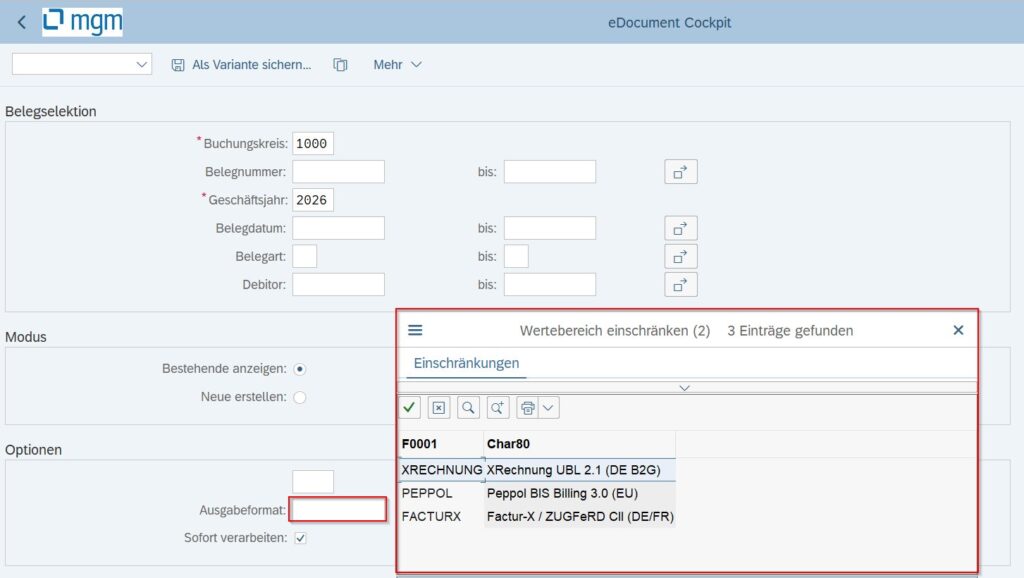
The solution handles five core tasks:
- Generation. E-invoicing-compliant XML is generated fully automatically from SAP documents — directly, without middleware, without manual bridging.
- Validation. Every invoice is checked against XSD schema and Schematron rules before leaving the system.
- Transmission. Either by email via SAPconnect, or as a file deposit on the application server and file system — depending on the process.
- Monitoring. Complete status tracking with error handling and audit trail — for auditors and internal revision.
- Customizing. Sender data, routing ID, and output paths are maintainable via configuration tables — without development, without external support.
Implementation takes four to eight weeks. The effort amounts to 25 to 30 person-days. Ongoing licenses, volume fees, cloud infrastructure costs: none.
Proof, Not Promises: The KoSIT Validation
“Ready and validated” is a claim that must be substantiated — particularly in a finance context. The official testing standard in Germany is validation by the Coordination Office for IT Standards (KoSIT). The validation tool is publicly available and is used as the benchmark for platform solutions as well.
An invoice generated in the mgm eDocument Cockpit passes this test:

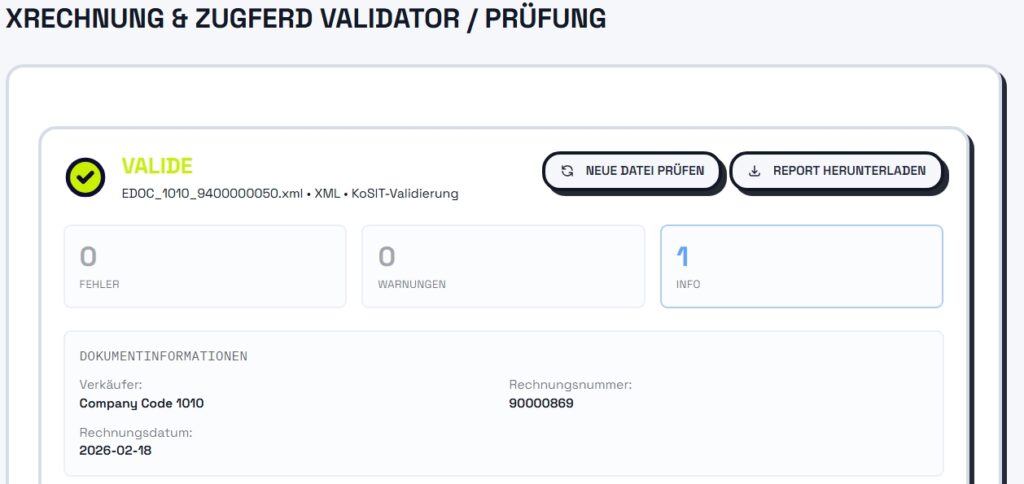
This result is more than a technical checkbox. It is the foundation that ensures invoices generated in production will be accepted by recipients, approved by auditors, and processed through the federal e-invoicing portal. Without this proof, any e-invoicing solution remains a promise. With it, it becomes ready for use.
Three Points That Matter at the Leadership Level
What makes this approach strategically relevant for CFOs and executive management?
Ownership instead of subscription. The solution is an ABAP custom development and resides in the customer’s system. The code belongs to the customer. That means no dependency on external roadmaps, no pricing adjustment risk from third parties, no vendor lock-in effects.
Modular extensibility. Peppol connectivity, ZUGFeRD format, incoming invoices, 25+ EU countries — all of this can be added when the need arises. But only then. Companies do not invest in capabilities they do not need today.
Calculable risk. The solution is complete, validated, and in productive use. That reduces project risk, shortens implementation timelines, and makes the go-live date plannable.
When a Platform Is the Better Choice
To be candid: there are scenarios in which a comprehensive platform is the right architectural decision. International corporations with compliance requirements across dozens of countries. Companies already broadly deploying a cloud platform and expanding it strategically. Organizations with dedicated compliance teams requiring a full reporting suite.
For these groups, the large solution is often the appropriate one. For mid-sized companies with an SAP focus and a German B2B core, it rarely is.
The question, then, is not: platform or custom development? The question is: what fits our actual requirements — today and in five years?
Conclusion: Effectiveness Over Reflex
The e-invoicing obligation is mandatory — how you implement it is strategy. Those who choose the path that feels easiest in the moment often pay twice: once for what they need, and once for what they never use.
A pragmatic, SAP-native approach is not a step backward. It is a deliberate choice for digital sovereignty, for predictable costs, and for independence. For many mid-sized companies, it is the more effective answer — not despite its simplicity, but because of it.
For us, Innovation Implemented does not mean tackling every problem with the largest available solution. It means the right solution at the right time — pragmatic, effective, and as lean as possible.