

Last Updated on 6. August 2026
Technical debt often can’t be addressed in the day-to-day business of many product teams until it reaches a critical mass and thereby the attention of those responsible. At the same time, the very scope of change that then needs to be tackled is one of the main reasons for further inaction. That we now have the means to master such challenges faster and with a lighter touch is what mgm technology partners demonstrated at the K5 Future Retail Conference 2026: with a pilot project that internally tested a frontend replacement via Agentic Coding. In no more than 10 person-days, a single developer implemented a functional migration between two incompatible frameworks.
In a masterclass, Paul Böhme, Project Manager and Agile Coach at mgm technology partners, together with Philipp Hofmann, Senior Solutions Engineer at commercetools, therefore presented not a conceptual talk but a project report with concrete figures.
From Replatforming to Strategic Realignment: Frontend Migration for a commercetools System
Since 2023, mgm has been working with a European fashion client. After replatforming to the composable commerce platform Commercetools, MGM also took responsibility for ongoing development. However, the decision to use SvelteKit as the front-end technology created repeated challenges, pointing to a potential strategic realignment: migrating to the established e-commerce standard, React/Next.js. This would establish a more sustainable technical foundation in terms of maintainability and talent pool.
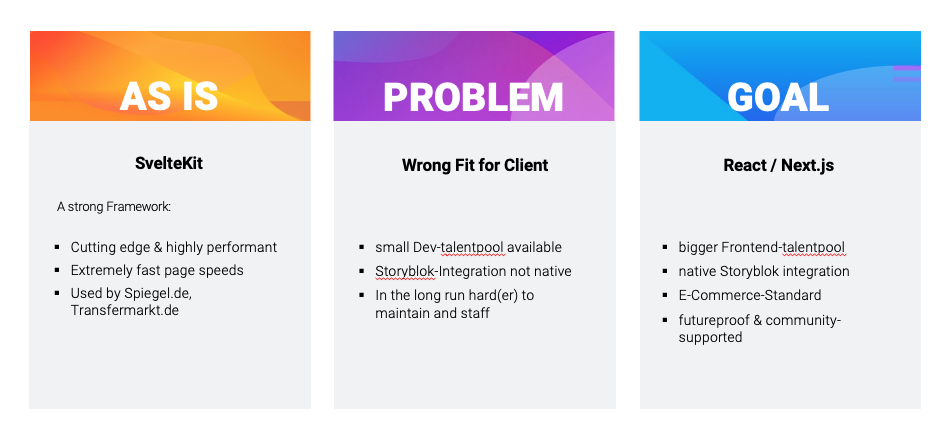
The real question, however, was not which target technology to choose, but how such a switch could be implemented in an economically viable way. mgm used the project as an internal lighthouse initiative to test an agentic development approach. The client provided access to the codebase for this purpose. A full migration had not yet been commissioned at the time of this proof of concept.
Frontend Migration from SvelteKit to Next.js: Not a Move, but a Rebuild from Blueprint
What is referred to as a “migration” for simplicity is, in the strictest technical sense, a rebuild. SvelteKit and React/Next.js differ fundamentally in areas such as state management, routing, and reactivity, which is why a 1:1 translation of code is not possible.
The agentic approach solves this problem in two stages: first, specialized AI agents capture the behavior, structure, and appearance of each component in a technology-neutral way. A further agent then designs the implementation in the target technology. The specifications captured in a specific intermediate format are then newly implemented in React/Next.js. The result is a functional migration, including “look and feel” — but the code itself is rewritten from scratch in the target framework.
Agentic Coding Pipeline: Four specialized AI agents replace classic developer capacity.
In their Masterclass, Paul Böhme and Philipp Hofmann first place Agentic Coding into a conceptual framework. They describe four stages of AI-supported development: from simple prompting, through co-piloting and vibe coding, to full Agentic Coding.
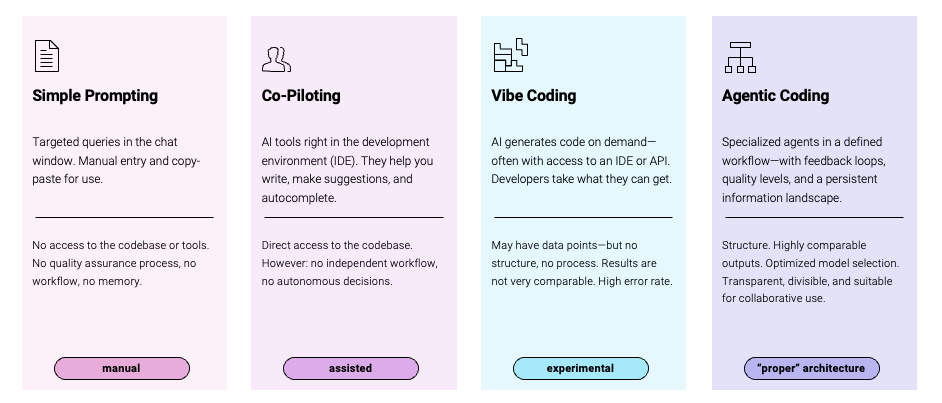
The difference between the individual stages doesn’t lie solely in the degree of autonomy: in the agentic pipeline, the black box of vibe coding dissolves into coordinated units of work with assured quality. What matters is the transparency of the work steps and results, the assurance of quality, and the repeatability of the entire process while maintaining a consistent level of autonomy. The developer takes on a steering role as architect, pipeline designer, and final quality gateway — not as the one doing the implementation.
The core of the Agentic Coding approach is a multi-stage pipeline with four specialized AI agents that draw on Anthropic’s Claude model lineup.

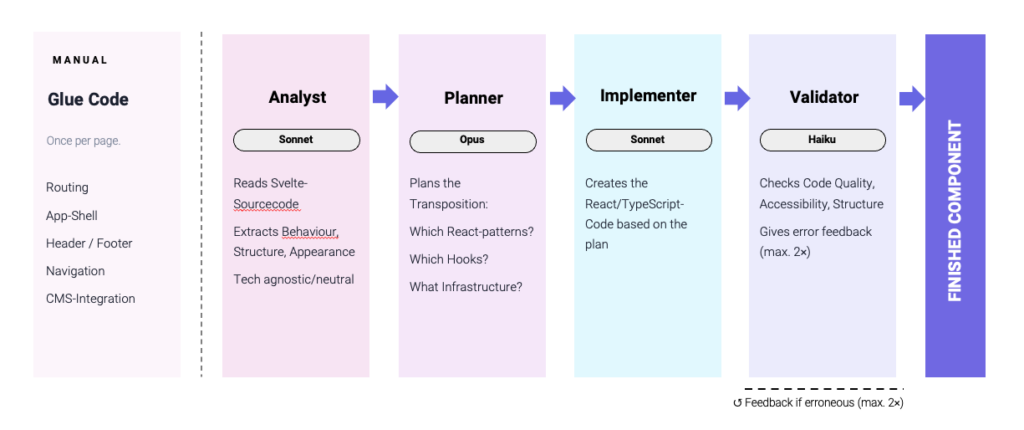
- 1. The analyst reads the Svelte source code and extracts its behavior, structure, and appearance into a technology-neutral intermediate format.
- 2. The planner translates this format into a concrete implementation plan for React/Next.js. This plan includes decisions regarding hooks, architectural patterns, and required infrastructure. This is where Claude Opus comes in — the most reasoning-capable model in the family.
- 3. The implementer writes the finished React/TypeScript code according to the plan. Claude Sonnet is used here.
- 4. The validator checks the generated code for correctness, accessibility, and completeness. If discrepancies are found, the Validator returns structured feedback in a maximum of two iterations. Claude Haiku is sufficient for this review task.
The task-specific choice of model is anything but a minor detail: within Anthropic’s Claude model family, Haiku is roughly 80 percent cheaper than Opus. Across a project, this adds up to a real cost lever.
“Agentic coding is neither a tool nor a prompt,” emphasizes Paul Böhme. “Rather, it is a well-designed workflow with specialized agents, clear quality gates, and human oversight at every critical point.”
The only elements that remain manual are the glue code components that connect different parts of the system. This includes routing, the app shell, the header, the footer, navigation, and CMS integration. These components require more direct, one-on-one coordination with a dedicated migration agent rather than the autonomous pipeline.
Agentic Coding Proof of Concept: Frontend Replacement with One Developer in One Month
The pilot was carried out and completed as an internal research and development project, detached from the ongoing client project, based on the codebase made available. The result is a functional shop instance, fully demo-capable within the scope of the PoC.
The resources deployed comprised one part-time developer and a project manager with a small time allocation. Classically, at least two developers would have been needed for implementation and review, since whoever writes the code cannot review it objectively. The agentic approach solves this problem, as the developer acts as architect and reviewer rather than as implementer. Another major capacity factor: agentic access to the codebase allows for “autonomous” onboarding. The pipeline familiarizes itself with the shop’s current state during initialization, reducing the subject-matter onboarding to a bare minimum.
The pipeline outputs were continuously validated against three “manually” migrated reference components. This showed a structural and visual match of 100 percent for the migrated components.
An interesting look back at traditional project work: the architect of the replatforming estimated the full migration project at 200 to 250 person-days using a classic, manual approach. The PoC showed that this effort can be reduced to around 20 percent through an agentic approach.
Agentic Engineering Shifts the Resource Logic: From Development Capacity to Architecture Expertise.
The proof of concept establishes the feasibility of agentic software development for this use case. The broader finding is structural in nature: With an agentic approach, framework dependencies and technical debt can be addressed in a calculable and predictable way.
An interesting look back at traditional project work: the architect of the replatforming estimated the full migration project at 200 to 250 person-days using a classic, manual approach. The PoC showed that this effort can be reduced to around 20 percent through an agentic approach.
What changes here is the resource logic. The limiting factor is no longer development capacity, but architectural competence.

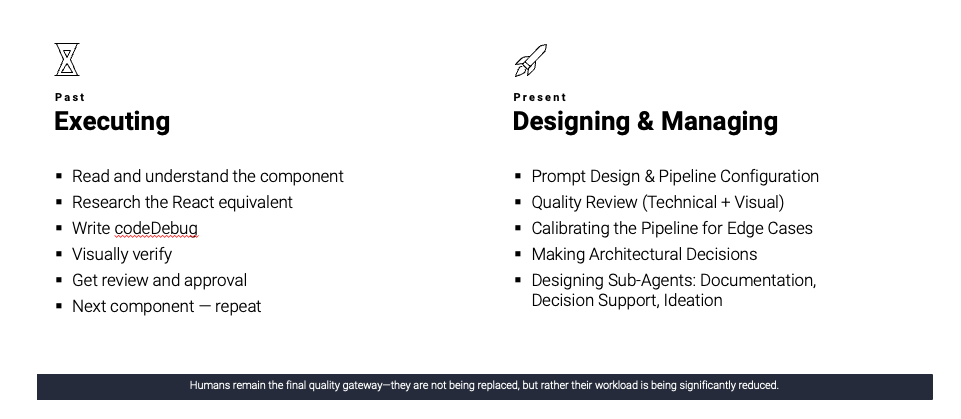
“The bottleneck has shifted,” says Paul Böhme. “It’s no longer that we don’t have enough developers. Now, we need architects—or better yet, migration leads. We need people who can design systems and workflows and lead projects. Coding alone is no longer enough.”
For e-commerce organizations, this means concretely that platform decisions should be influenced less by short-term migration costs.
“Technical debt is no longer fate,” says Böhme. “Framework migration, component rebuilds, legacy modernization — with an agentic approach, all of this becomes calculable. The concept has been proven.”
Further information
- Recording of the K5 Masterclass “Agentic Coding in Practice: Insights from a Frontend Replacement”: https://k5.de/video/agentic-coding-im-praxistest-insights-aus-einem-frontend-replacement/
- mgm Commerce website and contact: https://www.mgm-tp.com/e-commerce.html